One Hold to Hurt Them All: How Crimping Your Way Through Every Route Is Wrecking Your Fingers
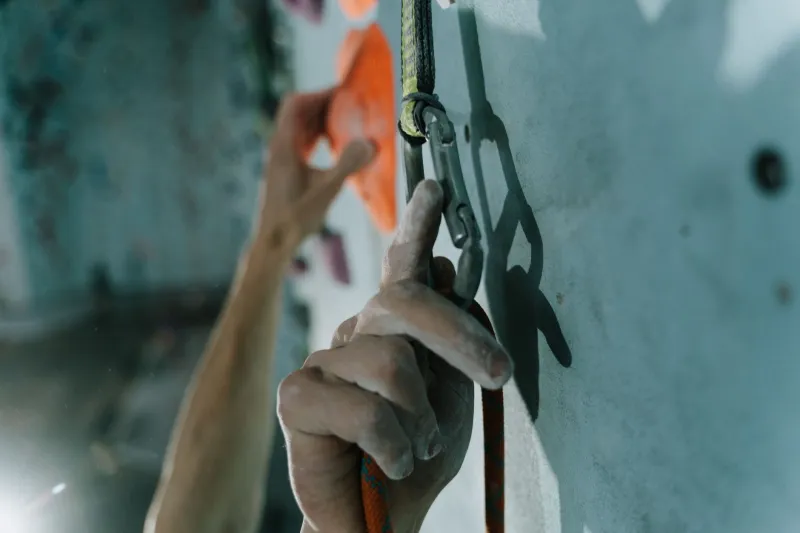
There's a moment every climber knows. You're scanning a route, your eyes jump from hold to hold, and without even thinking about it, your brain is already sorting — that one's good, that one's bad, that one I can work with. What you probably don't realize is that your definition of "good" has been quietly narrowing for years.
For a huge chunk of gym climbers, "good" basically means one thing: a crimp. And that preference, baked in over hundreds of sessions, is doing some real damage.
Why Climbers Default to the Crimp
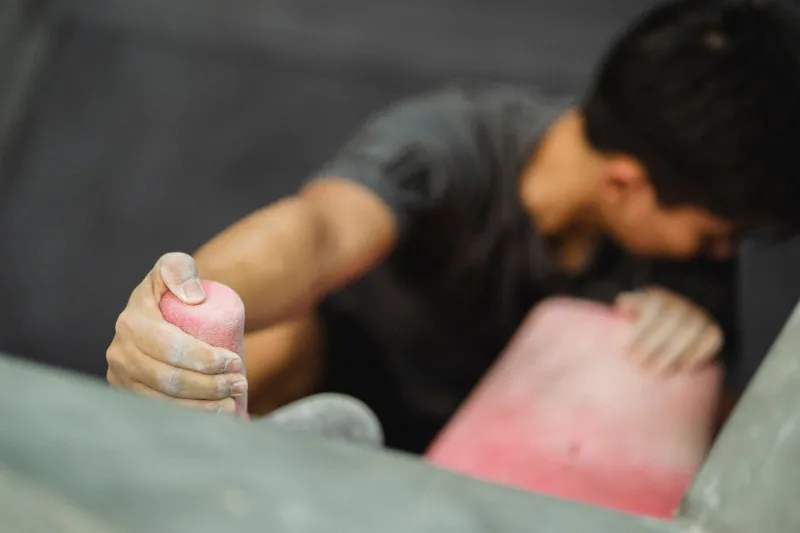
Crimping feels powerful. When you curl your fingers over a small edge and lock down, there's an immediate sense of control — a mechanical advantage that open-hand gripping just doesn't deliver in the same way. Gyms, especially older or more competition-influenced ones, tend to set routes loaded with those satisfying little edges. You train on them constantly. You get stronger on them. And then, almost by accident, they become the only hold type you actually trust.
The problem isn't that crimping is bad. It's that it's become a crutch — and crutches, used long enough, create imbalances that eventually snap.
Biomechanically, the full crimp position (fingers hyperextended at the first joint, thumb wrapped over the index finger) generates serious force through a relatively small contact area. That force has to go somewhere, and a lot of it runs directly through the A2 pulley — the ligament sitting at the base of your ring finger. Sound familiar? The A2 pulley is the single most commonly injured structure in climbing. It is not a coincidence that it's also the structure most stressed by the grip position most climbers use most often.
The Gym Versus the Rock
Here's where things get interesting — and a little inconvenient.
Outdoor rock doesn't care about your favorite hold type. A granite face in Yosemite, a sandstone pocket paradise in the Red River Gorge, a gneiss slab out in the Carolinas — these places throw sloper systems, pinches, pockets, gastons, and underclings at you whether you're ready or not. The gym, for all its virtues, has conditioned a lot of climbers to expect holds that fit neatly into one comfortable grip pattern.
When you hit real rock and suddenly need to open-hand a sloper or pinch a flake with your whole hand, you're recruiting tendons and positions that haven't been meaningfully loaded in months. That's not just a technique problem — it's a tissue readiness problem. Tendons adapt slowly. If yours have been living in crimp-land exclusively, they're not ready for the demands that outdoor climbing is about to make.
This is exactly how climbers get hurt on routes that are technically below their grade. Not because the climbing was too hard, but because the type of hard was completely different from what they'd trained for.
The Grip Spectrum You're Probably Ignoring
Let's break down what most climbers are undertraining:
Open-hand grip — fingers extended at roughly 90 degrees, no hyperextension. Distributes force across more tendon surface area, significantly lower injury risk, and essential for slopers and rounded holds. Most gym climbers use this far less than they should.
Pinch — thumb opposition against the fingers. Requires wrist stability and recruits different forearm muscles entirely. Outdoor rock is full of pinches. Gym training often isn't.
Pocket loading — two-finger and mono positions that isolate specific tendons. These need to be trained carefully and progressively, but ignoring them entirely leaves you unprepared for pocketed limestone or volcanic tuff.
Sloper contact — less about finger flexion and more about friction, wrist angle, and upper body positioning. Slopers punish climbers who've over-relied on crimps because the strength transfer is surprisingly low.
If you can't remember the last time you deliberately trained any of these, that's the problem.
Building a Deliberate Hold-Type Practice
The fix isn't complicated, but it does require some intentionality — which is exactly what most of us skip when we're just trying to have fun at the gym.
Audit your sessions. For one week, pay attention to which holds you gravitate toward when you have a choice. Route reading, rest positioning, warm-up laps — all of it. You'll probably find a pattern pretty quickly.
Set a hold-type rotation. Pick one session per week where you deliberately avoid your comfort grip. If you're a compulsive crimper, spend a full warm-up and a few easier routes using only open-hand. It'll feel weak at first. That weakness is information.
Use hangboard work strategically. The hangboard is one of the few places where you can load specific grip positions in a controlled, measurable way. If you're only hanging on two-pad crimps, you're leaving a lot of adaptation on the table. Add open-hand sets. Add pinch block work. Keep the loads conservative when you're first introducing new positions — tendons take 8–12 weeks to meaningfully adapt, and rushing that process is how you end up on the injured list.
Seek out uncomfortable outdoor terrain. If you're mostly a sport climber who haunts well-bolted limestone crags, go find a granite slab day or a sandstone session where slopers and pinches dominate. Let the rock force you into positions the gym never would. This is genuinely one of the best training tools available, and it's basically free.
Give open-hand priority on easy terrain. When you're warming up on routes well below your limit, there's no reason to crimp. Use those laps to build open-hand strength and ingrain the habit at low stakes.
What Recovery Actually Looks Like
If you're already dealing with finger pain — that familiar twinge in the A2 region, the puffiness around your ring finger's first joint, the sensation that something's just not right — the answer is almost never to push through. It's also not necessarily to stop climbing entirely.
Load management is the concept you want. Back off intensity, drop to open-hand on easier terrain, and start addressing the hold-type imbalance that likely contributed to the problem in the first place. A lot of climbers spend their recovery time doing exactly the same training that got them hurt, just with less weight. That's not recovery — that's just slower damage.
Work with a sports physical therapist who actually understands climbing if you can find one. The climbing injury rehab space has gotten significantly better in the last few years, and there are practitioners across the US who specialize in exactly this stuff.
The Bigger Picture
Crimping isn't the enemy. It's a legitimate and necessary skill that you'll use for the rest of your climbing life. But when it becomes the only tool in the box, you stop being a well-rounded climber and start being a very specialized one — specialized in a way that leaves you fragile on anything that doesn't fit the pattern.
The climbers who stay healthy and keep progressing into their 40s and beyond aren't the ones who found the perfect crimp strength. They're the ones who built durable, adaptable hands that could handle whatever the rock threw at them. That starts with being honest about what you've been avoiding — and then going and training it anyway.