One Grip to Rule Them All? Why Climbers Who Skip Grip Variety Are Getting Wrecked Outside
There's a move that happens at nearly every climbing gym in America. Someone walks up to the hangboard, loads up their favorite edge, and proceeds to grind out set after set with the focused intensity of someone training for the Olympics. It looks productive. It feels productive. The fingers get pumped, the forearms scream, and there's a satisfying sense of work getting done.
The problem? That same climber shows up at a crag in the Southeast — say, something like the sloper-heavy lines at Rocktown in Georgia or the weird, pinchy stuff at Horse Pens 40 in Alabama — and falls apart completely. Not because they aren't strong. Because they're strong in exactly one way, and the rock outside doesn't speak that language.
This is the grip variety trap, and more climbers are stuck in it than they realize.
Why Crimps Feel Like the Right Answer
Crimps are seductive for a simple reason: they're easy to measure and easy to overload. You can hang a specific edge depth, add weight with a belt, track your numbers over time, and watch them go up. That feedback loop feels like progress because, structurally, it is progress — just very narrow progress.
The hangboard has done incredible things for the sport. Climbers are sending harder than ever, and structured finger training deserves some of the credit. But the hangboard also has a blind spot baked into how most people use it. The vast majority of training protocols lean heavily on half-crimp and full-crimp positions on edges between 18mm and 20mm. That's a useful strength to develop. It's just not the whole story.
Outdoor rock is weird. It's irregular, unpredictable, and completely indifferent to your training preferences. A route might demand open-hand pulling on rounded quartzite, then transition immediately into a two-finger pocket move, then ask you to push down on a sloper with your palm while your feet smear. If you've spent 90 percent of your training time in one grip position, you've essentially shown up to a multi-sport competition having practiced only one event.
The Grips Most Climbers Are Neglecting
Let's break down what tends to get left on the table.
Open-hand grip is probably the most undertraining-ed position relative to its outdoor usefulness. It's safer on tendons, transfers well to rounded holds and slopers, and builds a different kind of finger strength than the crimped position. Most climbers avoid it because it feels weaker — which is exactly why it needs more work.
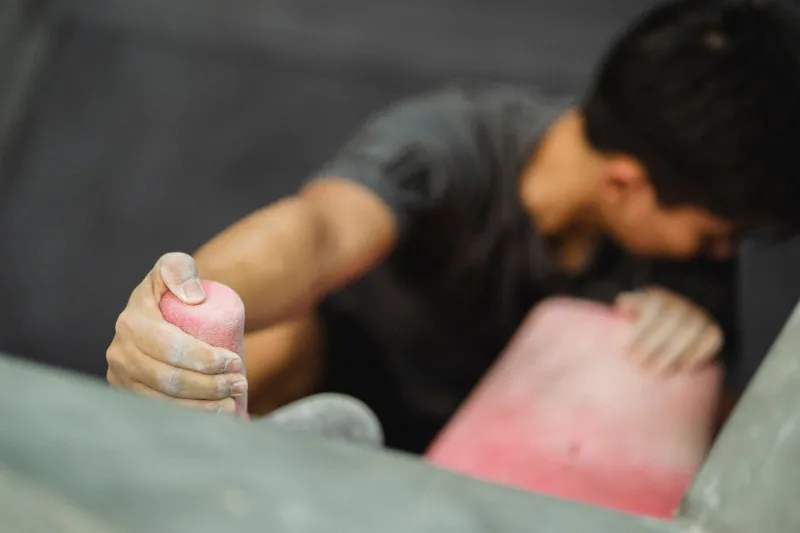
Slopers get their own category because pulling on them isn't really a finger strength problem at all. It's a friction, wrist angle, and shoulder position problem. Climbers who skip sloper training don't just lack grip strength on those holds — they lack the body awareness to use them correctly. You can be incredibly strong on edges and still have no idea what to do with a sloper at shoulder height.
Pinches are chronically undertrained despite showing up constantly on outdoor rock — especially on features like arêtes, small fins of rock, and compression problems. The thumb is a wildly underutilized asset in most training programs. Developing pinch strength also tends to improve overall hand stability in ways that carry over broadly.
Two-finger pockets deserve specific attention because the pocket game on outdoor limestone, basalt, and certain sandstone formations is entirely different from what most gyms replicate. The ring-middle combination and the middle-index combination have meaningfully different strength profiles, and training both matters if you're going anywhere pockets are the menu.
How Grip Monotony Creates Movement Gaps
Here's what makes this more than just a strength issue: grip dependency shapes how you read rock.
When you've trained primarily one way, your brain starts filtering holds through that lens. You'll unconsciously seek out the crimp, adjust your body position to force a crimp where a sloper would actually work better, and miss movement solutions that don't fit your trained pattern. This is why some climbers who are genuinely strong on the hangboard struggle to transfer that strength onto outdoor routes — they're not just physically underprepared for certain holds, they're mentally unprepared to see them as options.
Grip variety training isn't just about building more finger strength. It's about expanding your movement vocabulary so that when rock hands you something unexpected, your body has a reference point for what to do.
A Monthly Rotation to Build Real All-Around Hand Strength
The fix doesn't require rebuilding your entire training program from scratch. A simple monthly rotation can fill the gaps without sacrificing the crimp work that's actually serving you.
Week 1 — Edge and Open Hand Focus: Keep your standard hangboard work but consciously split your sets between half-crimp and open-hand positions. If you normally do five sets of half-crimp, make two of them open-hand. Track both. The gap between your numbers will tell you a lot.
Week 2 — Pinch and Thumb Activation: Add pinch-specific loading at least twice this week. A simple setup is a smooth pinch block (a piece of wood works fine) with weight added via a bucket or belt. Include some thumb-opposition movements — pulling up on a rounded hold while actively pressing the thumb into it is a good starting point.
Week 3 — Sloper and Friction Work: This week, dedicate one session specifically to sloper movement on the wall. Don't just hang on them — actually climb problems that force you to use them. Pay attention to wrist angle and shoulder position. If your gym has a spray wall or a woody, this is where it earns its keep.
Week 4 — Pocket Isolation: If your fingers are healthy and conditioned, add some two-finger pocket work on a hangboard or a portable pocket block. Go lighter than you think you need to. Pockets load tendons differently than edges, and the point here is recruitment and adaptation, not max loading.
Rotate through this cycle consistently over a few months and you'll start noticing things. Your sloper reading will sharpen. Your open-hand strength will close the gap with your crimp numbers. You'll stop flinching when a route hands you something your hangboard doesn't have.
The Bigger Picture
Outdoor climbing has always demanded adaptability. The rock doesn't care what your training protocol looks like — it just presents what it presents, and you either have the tools or you don't. Building a genuinely complete grip repertoire isn't about abandoning the work you've already done. It's about making sure that work actually shows up when the terrain gets weird.
The climbers who move best outside tend to be the ones who've made peace with feeling weak on something and then done the work to fix it. That's not a comfortable process. But it's the one that actually transfers.
So next time you load up the hangboard, ask yourself: am I getting stronger, or am I just getting better at the one thing I already know how to do?