When the Climbing Community Becomes the Thing That's Holding You Back
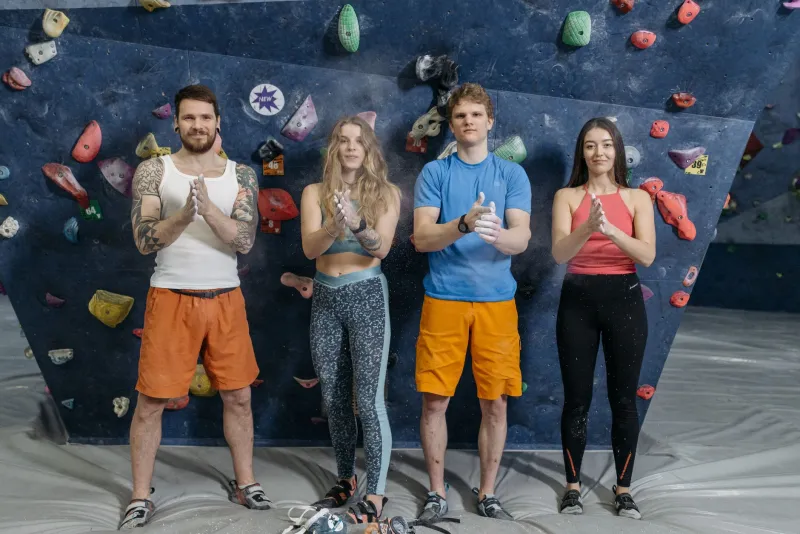
There's a moment a lot of climbers know but rarely talk about. You show up to the gym, lace your shoes, and somewhere between your warm-up and your project, you feel it — that low-grade dread. Not fear of the climb. Fear of the people watching.
Climbing has always marketed itself as the welcoming alternative to team sports. No bench. No coaches cutting you. Just you, the rock, and a community of like-minded adventurers. And for a lot of people, that's exactly what it is. But for a growing number of climbers — especially newer ones, women, climbers of color, and anyone outside the sport's historically narrow demographic — the community itself has quietly become one of the biggest obstacles to staying in the sport.
This isn't a comfortable thing to say. But it needs to be said.
The Gym Vibe Isn't Always What It Looks Like on Instagram
Walk into most climbing gyms in the US and the surface-level culture looks great. People cheering each other on, sharing beta, fist-bumping after sends. That part is real. But underneath it, there's often a social hierarchy running on an invisible scoreboard — and if you don't know the rules, you're already losing.
Grade chasing is the most obvious symptom. When a gym's social culture revolves entirely around what number you're projecting, it creates a subtle but constant pressure to perform. Climbers start sandbagging their grades in conversation, inflating their sends, or — worse — avoiding certain problems altogether because failing publicly feels too costly.
The result? People stop taking risks. And in climbing, risk-taking is literally the whole point.
Research in sports psychology consistently shows that environments dominated by ego-oriented goals — where success means being better than others — suppress intrinsic motivation over time. Climbers in those environments start climbing for external validation rather than for the actual joy of movement. Eventually, many of them just stop showing up.
The Gatekeeping Nobody Admits Is Happening
Ask any climber who's been in the sport more than a decade and they'll have a gatekeeping story. Maybe it's the regular who monopolized the wall and made it clear through body language alone that you weren't welcome on their project. Maybe it's the unsolicited beta from someone who didn't ask if you wanted help. Maybe it's the group that never quite made room at the crag for anyone outside their circle.
Gatekeeping in climbing wears a lot of disguises. Sometimes it's overt — dismissive comments about gym climbers not being "real" climbers, or condescension toward anyone who doesn't have trad experience. More often it's subtle: the way certain people talk over others in conversations about gear, the implicit assumption that everyone in the group has the same financial access to travel or equipment, the casual alpha-climber energy that makes a 5.10 leader feel like they need to apologize for existing.
None of this is unique to climbing. But the sport's self-mythology as an inherently inclusive community makes it harder to name and address. You can't fix a problem the culture refuses to acknowledge.
Social Media Made It Worse
Climbing content on Instagram and TikTok is, objectively, incredible to watch. It's also doing real psychological damage to a lot of climbers.
The comparison trap isn't new, but the scale of it is. A climber in Chattanooga or Salt Lake City now has a daily feed of world-class athletes making V12 look effortless, influencers with sponsorships and perfect lighting, and gym regulars posting their sends like highlight reels. When that's the constant baseline, your actual climbing life — the falls, the plateaus, the days when 5.11 feels like a struggle — starts to feel like failure.
What doesn't show up in feeds: the years of training behind a hard send, the bad days, the injuries, the self-doubt. The algorithm rewards the exceptional moment, not the ordinary grind that produces it. And when ordinary climbers internalize that distortion, they start measuring their worth by standards that were never meant to apply to them.
Some climbers respond by withdrawing. They stop posting, stop going to the gym, stop climbing outdoors because they feel like they're not "at the level" where they belong on real rock. That's not a personal failure — that's a predictable response to a toxic information environment.
What Healthy Climbing Community Actually Looks Like
Here's the thing: the antidote to a bad climbing community isn't to climb alone. Isolation doesn't fix the problem, it just removes you from it. What actually works is being more intentional about who you climb with and how you measure your own progress.
Find your people, not the popular crowd. The climbers who will actually fuel your progression are usually not the loudest ones in the gym. They're the ones asking genuine questions, encouraging falls as much as sends, and showing up consistently without making a production of it. Seek those people out. They exist in every gym.
Set process goals, not just grade goals. If your only metric is what number you're climbing, you've handed your motivation over to a system that's designed to make you feel behind. Instead, track things you actually control: footwork improvement, route-reading speed, how efficiently you rest on a route. Progress on those fronts is real regardless of what grade it adds up to.
Be the culture you want to climb in. This sounds cheesy, but it's practical. Ask before giving beta. Celebrate other people's progress out loud. Share your failures as readily as your sends. One person doing this consistently shifts the vibe of a gym more than any posted policy ever could.
Take a break from the feed. Not forever — but strategically. A week off social media during a period of heavy training or a tough plateau can reset your baseline for what normal looks like. You start measuring yourself against your own last session instead of someone else's career highlight.
Talk about the hard stuff. Motivation dips, comparison spirals, feeling unwelcome — these conversations happen in private between climbing partners but almost never in public. Normalizing them changes the culture. When you're honest about your own mental experience in climbing, you give other people permission to be honest about theirs.
The Community Is Worth Fighting For
None of this means the climbing community is beyond repair — far from it. At its best, it's genuinely one of the most supportive athletic cultures in the US. The problem is that "at its best" isn't consistent enough, and the climbers getting pushed out are often exactly the ones who would make it richer.
If you've been feeling the slow drain of motivation and you can't pin it on training load or injury, look at the social environment you're climbing in. Sometimes the crux isn't on the wall. Sometimes it's in the room.
You deserve to climb in a community that makes you feel like you belong on the rock — not like you're constantly auditioning for the right to be there.